‘In 1970, Yoshida Roshi, Abbess of Kaizenji Monastery in Nagoya, Japan, came to visit San Francisco Zen Center. Suzuki Roshi had sent Joyce Browning to Kaizenji and her husband, Ron, to Eiheiji for training and Yoshida Roshi was very curious to see where Joyce had come from. She found seven priests here wearing “store bought” robes and she encouraged Suzuki Roshi to have SFZC take up the practice of Nyoho-e, or “clothing made according to the Dharma.” This was a movement in Japan that took hold during the 20th Century, when monks returned to sewing robes in the way they had during Buddha’s time. Yoshida Roshi offered to do a sewing sesshin so that ordained people could learn how to sew robes in this traditional way.
“At that time, it was actually the wives and girlfriends who did most of the sewing,” Blanche added wryly.
Virginia and Richard Baker were living in Japan at the time and Yoshida Roshi suggested that Virginia study sewing with Joshin-san Kasai, a nun at Antaiji Monastery. After Suzuki Roshi’s death, Richard invited Joshin-san to come to SFZC to help instill a sewing practice here.
When Blanche came to SFZC, Pat Herreshoff, who died recently at the age of 95, was Suzuki Roshi’s jisha, or attendant. She had studied in Japan and spoke Japanese, and she translated the sewing instructions into English.
“Then Joshin-san had them translated back into Japanese to make sure Pat had gotten them right!” Blanche said. When Joshin-san came back to Zen Center for a second visit, Blanche went to Tassajara, helping Joshin-san and sewing her own first rakusu.
“I didn’t sew very well, but because of my experience with carpentry, I understood things like ‘parallel’ and ‘perpendicular’ and ‘measure twice and cut once.’ I began to understand how the pieces come together. When I was done with my rakusu, Joshin-san showed it to Baker Roshi and from then on, I was her assistant. She was such a bright, lively person. As Ann Overton once said when speaking of Joshin-san, if she had repaired televisions, I would have learned how to do that, because I just wanted to hang out with her. I was so moved by her devotion to this practice.”
Joshin-san spoke Japanese to Blanche and Blanche spoke English to Joshin-san but somehow they understood one another, sometimes with the help of a translator.
Blanche recalls an antique dealer who collected old okesas who wanted to meet Joshin-san and learn how to repair and conserve them. When the two were introduced, there was a great outburst of Japanese and Kaz Tanahashi translated Joshin-san’s words: “Any okesa is the whole body of Buddha! Why would anyone want a collection!”’ (from the SFZC website)
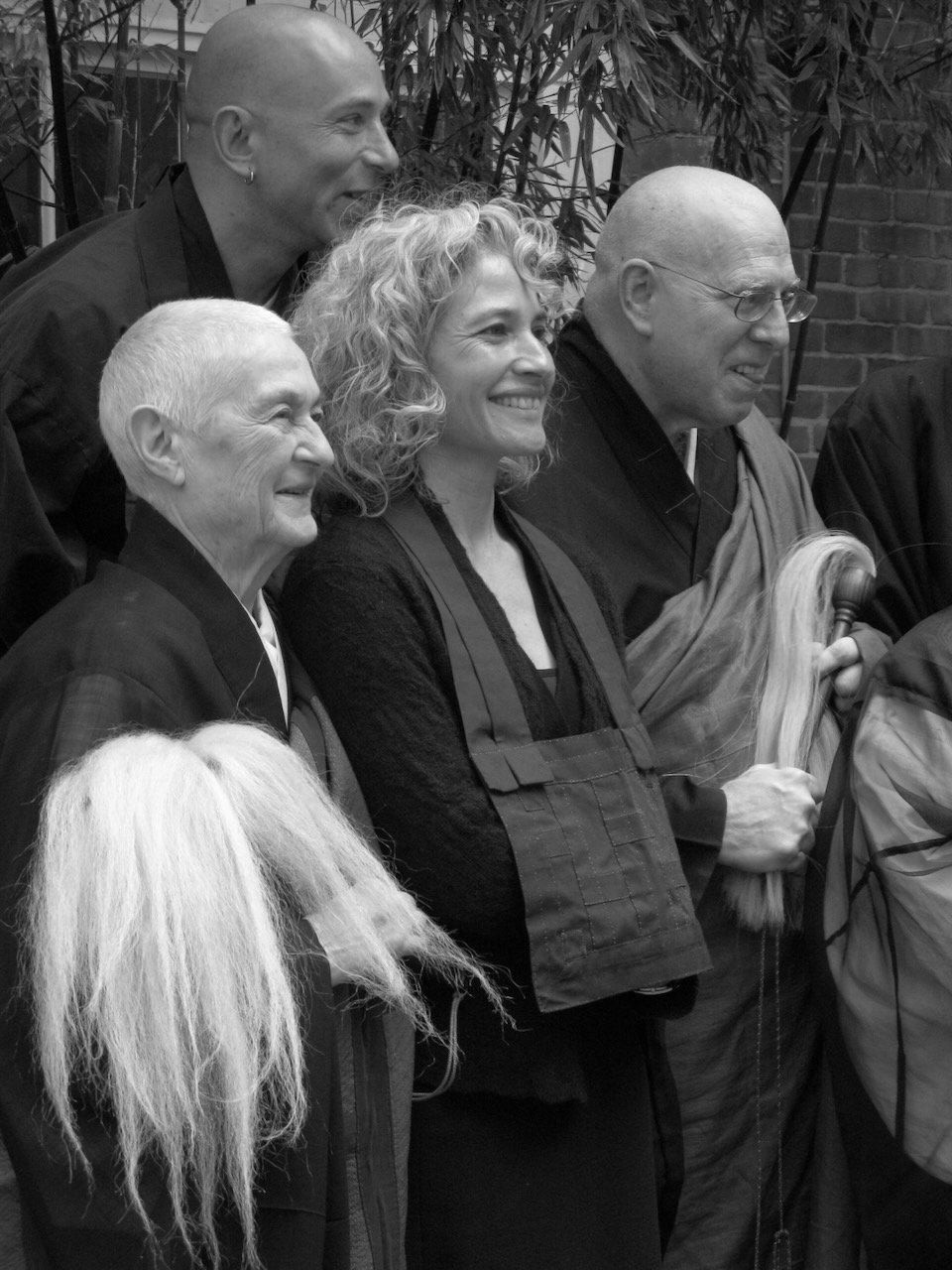
As someone who learnt about sewing from Blanche, I was touched by this story (the version on the website is longer). It happened that I was looking for a photo in my archive, and came across this, from the same ceremony pictured in the article. The person at the top is Tim, who now leads the sewing – which I am doing again. That is the way of the sangha.


Leave a Reply