Every now and again I spend some time in rabbit holes, usually related to spiritual communities gone wrong, or charismatic teachers who aren’t to be trusted.
I dug through my archive to find some of these examples: here on this blog, mildly so on Patreon with this post, this one and this one. This past week, on the day of the atmospheric river, when I had some time and space in the morning before a fuller afternoon, I ended up down a new one.
This was occasioned by seeing a piece mentioned in the New Yorker: I still receive the magazine, so when I saw it trailed in an email, I thought I would wait to read the hard copy, but then there was an Instagram post, and when I read that, and the comments, I realised not only that I had met the main person involved, but that there was much more to the story.
I thought I had written about my encounter with the group leader at the heart of all of this, but when I searched, it had remained as part of a draft post from the earliest years of this blog:
Recently I have noticed a similar jealousy in myself when I read about someone who has launched a meditation or mindfulness enterprise that is garnering a lot of media attention. One particular person, in a different part of the US, seems to have based their quite public teaching career on having attended one ten-day retreat. Again I ask myself whether I would want to jump through all the hoops to set up the kind of operation that this person, a reformed type-A entrepreneur by their own account, has done, and the answer is probably not.
This came to the fore over the weekend as I attended various parts of Wisdom 2.0. For the second year running, someone at Zen Center had been kind enough to offer me a ticket. Least year I went with some curiosity about what the market was looking for. The first event I enjoyed then was a mindful hike with Mark Coleman, but found myself frustrated with the number of people who had chosen to participate but talked to each other the whole way through, when the instruction was to discover the value of silence in an urban setting. Throughout the weekend last year I found myself silently exasperated at the number of people who seemed to be glued to Facebook and texts during presentations, even the most compelling ones (Byron Katie and Pico Iyer were the standouts for me). Although I made some valuable connections, the person I felt most drawn to for his groundedness and authentic energy turned out to be another zen priest…
I remember that we chatted a little, and I enjoyed the fact that I had seen him across a crowded room and had intuited that he had done zen training just from his demeanour. That was the extent of our connection.
In the comments on the Instagram post was a link to this piece by Kyle Hubbard which is extremely long, but also very well-written and fairly nuanced.
The first portion sets out terms, drawing on several very helpful ways of identifying problematic behaviour in what he prefers not to call cults:
In this checklist, [Jamie Wheal] overviews three red-flag clusters: the consolidation of charismatic power around a mythologized founder, the construction of in/out group boundaries via messianic purpose and specialized language, and the weaponization of peak experience and healing to bypass member discernment.
There was also this very helpful graphic:
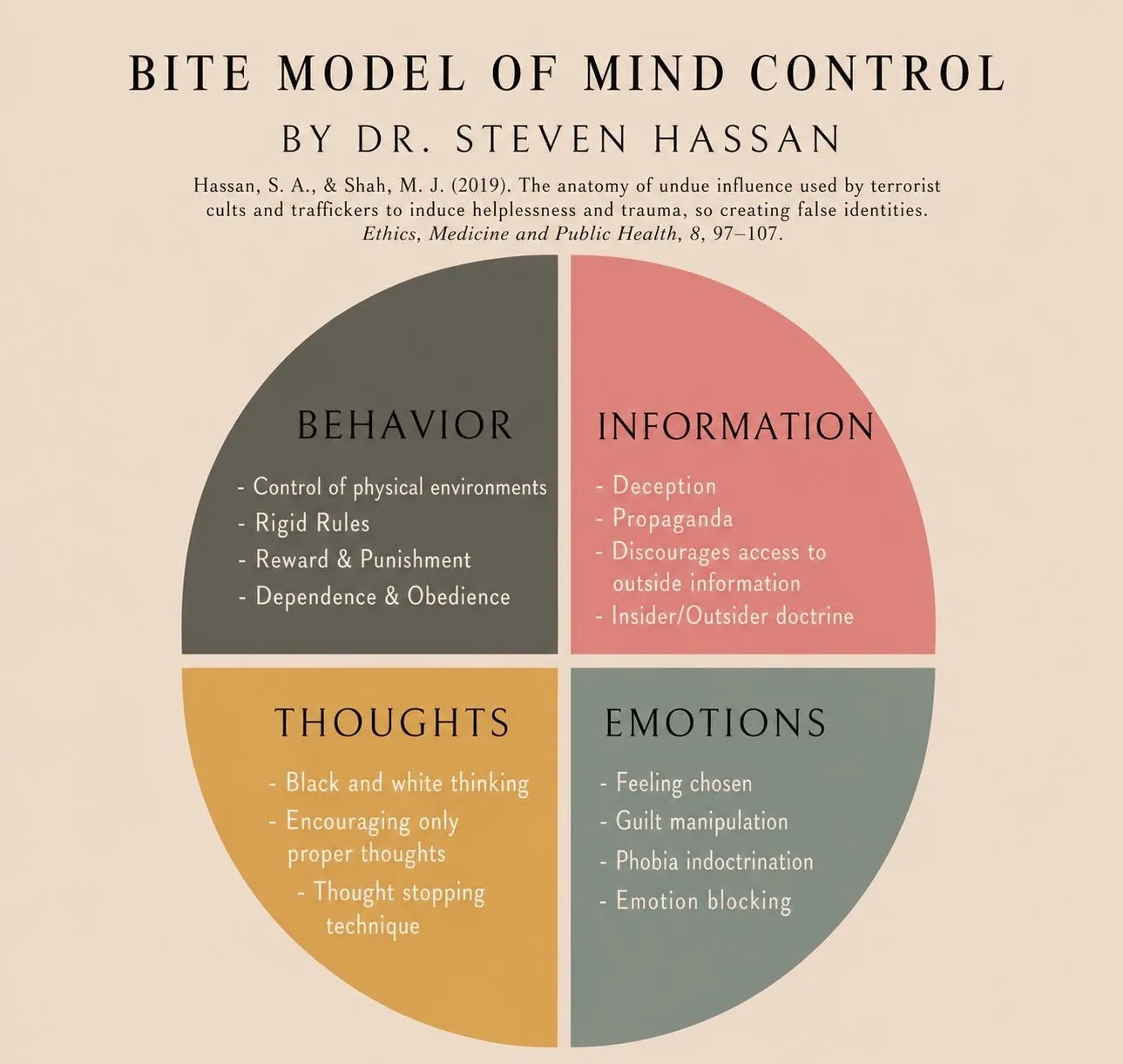
I always find it helpful to reflect back on my monastic training, and the parameters of Zen Center generally, to see how they match up. Hubbard helpfully adds this point:
So far, we have discussed dynamics that are common amongst the stricter monasteries of Japan and some in the US. I have stayed at another US Buddhist monastery with some amount of sleep deprivation, some amount of mandatory manual and administrative work, and a strict dress code. But many of these were less strict than at MAPLE, they weren’t accompanied by public mockery or demands for total exhaustion, and no other monastery I’ve visited (4) or am aware of includes the rest of the dynamics in the sections below.
Some of the teacher’s behaviour sounds adjacent to things I have read about in Japanese training. At San Francisco Zen Center, doubtless due to the temperament of Suzuki Roshi, that kind of thing was not much in evidence. I just read in David Chadwick’s stories about Tassajara how Joshu Sasaki suggested to David that he should come and train at Sasaki’s Rinzai temple, as it was tougher.
These days, given my own reluctance to be a figurehead, or teacher of a traditional centre, I wonder about how to guide people. I also noted in David’s book this little snippet about a teacher who visited at the inception of Tassajara:
I heard his own kyosaku down in Mexico bore the kanji for “Learn for yourself – I cannot teach you anything.”
Once a teacher starts challenging people not to slack off, or demeaning their efforts, as is described in the article, even in retreat settings, for the sake of breaking through resistance, there is always the danger of abuse. I don’t trust my own grasp of the teaching enough to want to go down that path. I have discussions with fellow priests about how soft to allow ourselves to be. For me the basis of teaching should always be encouragement, and in my time at Tassajara I generally understood the impersonal nature of the challenges: the schedule was not designed to punish me. If I chose to stay and submit to it, because I could see the value of pushing myself in that way, that was for my own benefit, not to fulfil any agenda of the abbot.
Another thing MAPLE does to limit exposure to other modes of spiritual thinking is to implicitly and sometimes explicitly position itself as having the true Dharma relative to every other Buddhist community in the West. Other teachers and communities are untrustworthy, lacking deep realization of the Dharma—or are even dangerous and corrupted by evil ideologies. Relationships students had with outside teachers were often sabotaged. Soryu explicitly stated that, if we study anything from teachers other than Soryu, they must be both Asian and ordained (thus excluding the entire Western world).
And here we definitely see red flags. At Zen Center there were always a multitude of teachers to practise with, and generally an allowance that people would be curious about other forms of the dharma.
As part of the reading, it appeared that, even having trained with one of the most respected Zen teachers in Japan, who I had at some points wanted to at least sit a sesshin with in this country, which he used to visit regulalry, he might not have been given authorisation to teach, which of course adds a whole other dimension to the stories.
There were other stories and accounts linked to as a part of this, so that it took me most of the morning to get through them all. In the end the New Yorker piece seemed painfully fluffy, an attempt to be light-hearted in dealing with the place, although you get a sense of something being off.
How is it that humans get so caught up in these messes, even those who have trained to set aside the ego, and want others to experience the benefit of this? I will never despair of the dharma, but it is hard to know how to bring it forth in a way that actually does benefit all beings.


Leave a Reply